
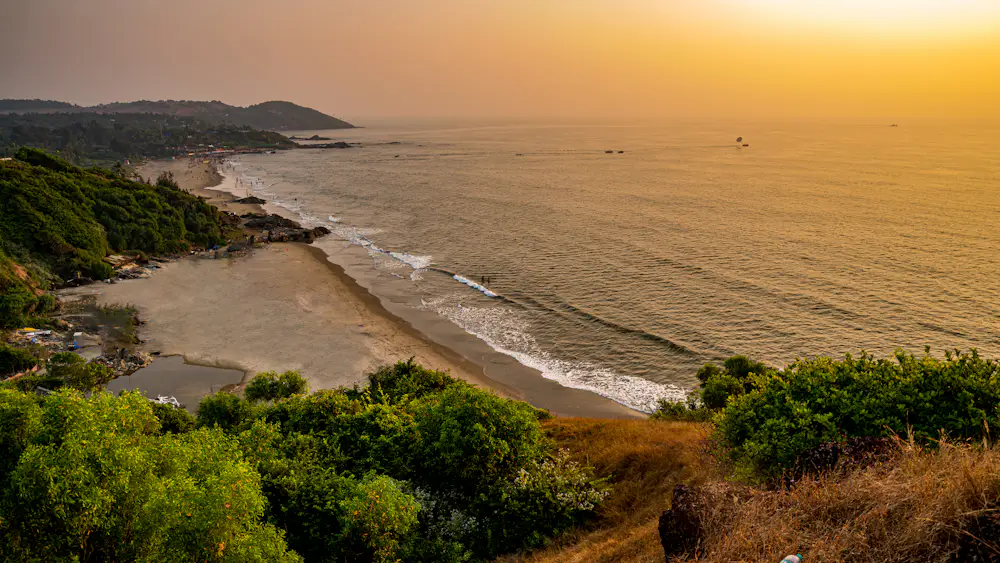
Chapora Fort is the ruined hilltop fort that looks down on Vagator beach, the Chapora river and, across the water, the long sands of Morjim. It is one of North Goa’s easiest historic sites to visit and one of the most rewarding at sunset. Very little of the interior survives, so what you are really going for is the walk along the walls and the view, with a bit of history to make sense of it.
Quick answer: Chapora Fort was first built under the Adil Shahi rulers of Bijapur and rebuilt by the Portuguese in 1717. It changed hands several times before being abandoned in 1892. Today it is a short, steep climb from the end of the access road near Chapora village. Go early morning or late afternoon, wear shoes with grip and carry water.
A short history
Adil Shahi origins
Before the Portuguese, this hill was fortified under the Adil Shahi dynasty of Bijapur. The fort was known as Shahpura, and that name is widely given as the origin of “Chapora”. The hill was valuable because it commanded the mouth of the Chapora river, a natural border and trade route.
Portuguese control and Maratha attacks
Bardez, the taluka that includes Vagator, came under Portuguese rule in the 16th century. The fort’s position on the northern frontier made it a target. Historical accounts describe Maratha forces under Sambhaji taking the fort in 1683, before the Portuguese recovered it.
The 1717 rebuild
The structure you see today largely dates from 1717, when the Portuguese rebuilt the fort on the earlier site. They strengthened it with bastions and are said to have built tunnels leading towards the sea and the river bank, intended for supply or escape during a siege.
Later years
The fort fell to the Bhonsles of Sawantwadi in 1739 and returned to the Portuguese in 1741. As the Portuguese gained the territories further north, Chapora lost its frontier role, and it was abandoned in 1892. Today the site is under the care of Goa’s Department of Archives and Archaeology.
Timeline
| Year | Event |
|---|---|
| Before Portuguese rule | Fortified under the Adil Shahi rulers as Shahpura |
| 1683 | Captured by Maratha forces under Sambhaji |
| 1717 | Rebuilt by the Portuguese on the earlier site |
| 1739 | Taken by the Bhonsles of Sawantwadi |
| 1741 | Returned to Portuguese control |
| 1892 | Abandoned |
| 2001 | Featured in Dil Chahta Hai, sparking its tourist popularity |
The Dil Chahta Hai effect
For many Indian visitors the fort is simply the “Dil Chahta Hai fort”. The 2001 film’s scene of three friends sitting on the walls turned it into a pilgrimage for a generation, and you will still see groups recreating the shot. It is a pleasant reason the fort stays busy, but expect company at sunset.
How to visit
Getting there
The fort is just north of Vagator, above Chapora village. Ride or take a taxi to the end of the access road, where there is limited parking, then walk up. The path is a mix of steps and rough laterite, short but steep. If you are coming from further afield, see how to reach Vagator.
What to bring
- Shoes or sandals with grip; the laterite is loose in places
- Water, especially from March onwards
- A torch if you plan to stay until after sunset
- A bag for your rubbish; bins are scarce
Timings and fees
Some sources give daytime hours of about 9.30 am to 5.30 pm, but the ruins are open ground and people visit outside those times. Check locally before relying on a time, and leave before dark if you are not confident on uneven ground.
Best time to visit
November to February brings the coolest weather and clearest skies. Within the day, go either early in the morning, when it is quiet, or about an hour before sunset. Midday climbs are hard work even in December. During the monsoon the paths are slippery and the grass grows high, but the views over a stormy sea can be dramatic. Our sunset points guide lists sunset times by month.
What you will see from the top
- North: The Chapora river mouth and, across it, Morjim beach and the Pernem coast.
- West: Open sea and, in the evening, the sunset.
- South: Big Vagator beach directly below, then the red cliffs of Ozran (Little Vagator).
- East: The river winding inland past fishing boats and the village of Chapora.
Look out for the old bastions and the remains of the walls. Traces of the tunnel openings mentioned in historical accounts are hard to identify without a guide, and much of the interior is grass and rubble.
Respect the site
Local reports have repeatedly raised the problem of litter at the fort. There is little signage or interpretation on site, so reading up beforehand helps. Do not climb on fragile sections of wall, and take everything you brought back down with you.
After the fort
From the top you can see the Ozran cliffs to the south, and it is a short ride there for dinner. Dubki, at 241/2 Ozran Beach, is a sea-facing restaurant and bar on those cliffs. For a post-climb meal, the non-veg menu has kebabs and sliders, and the menu with prices shows the full range. Call +91 86238 88190 to check it is open that evening.
FAQs
Who built Chapora Fort?
It was first fortified under the Adil Shahi rulers of Bijapur as Shahpura. The Portuguese rebuilt it in 1717.
How long is the climb?
It is short, typically 10–15 minutes at a relaxed pace, but steep and uneven.
Is there anything inside the fort?
Very little. The appeal is the walls and the views over the river and beaches.
Is Chapora Fort good for sunset?
Yes, it is one of the most popular sunset points in North Goa. Arrive early in peak season.
Hungry after the climb? Browse the full Dubki menu.