
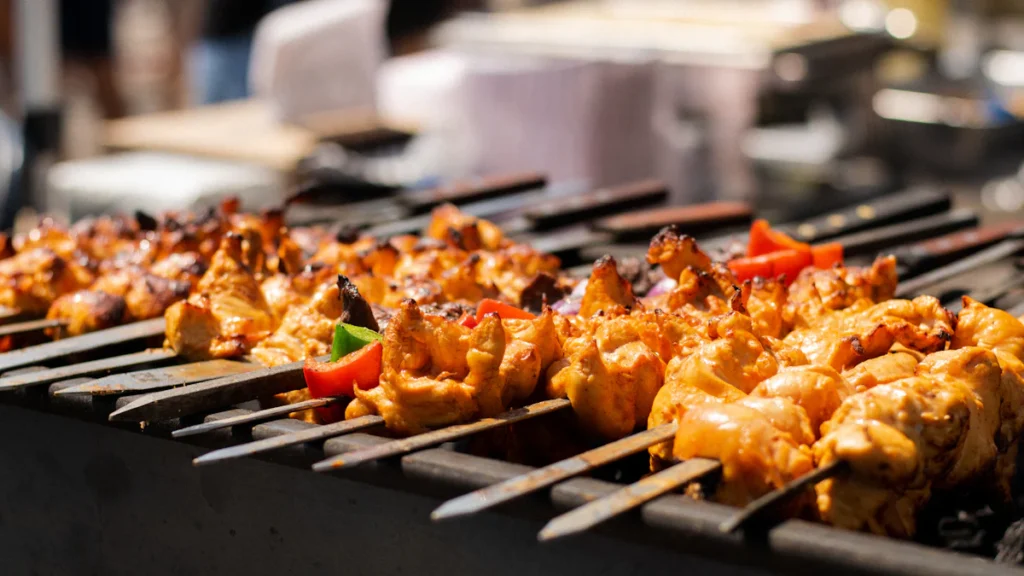
The three Dubki kebabs make up a small grill tour of the Middle East: a Persian Kebab with tandoori chicken, a saffron Joojeh Kebab and a Turkish Mutton Seekh Kebab with sumac and cardamom. They sit among the non-veg starters at Dubki – Dawn & Dusk Bar in Vagator, priced at ₹545 to ₹625. Knowing where each style comes from makes it much easier to choose between them, or to order all three.
Quick answer: Dubki has three kebabs. The Persian Kebab (₹545) is tandoori chicken with pita and badernjan. The Joojeh Kebab (₹545) is saffron chicken with zaatar bread and caramelised orange. The Turkish Mutton Seekh Kebab (₹625) is minced mutton with sumac and cardamom, served with babaganoush and sour cream. All three cost ₹1,715, around ₹1,981 with service charge and GST.
The three kebabs side by side
| Kebab | Price | Meat | Flavour notes | Served with |
|---|---|---|---|---|
| Persian Kebab | ₹545 | Chicken | Tandoori spice, smoky | Pita, badernjan |
| Joojeh Kebab | ₹545 | Chicken | Saffron, fragrant | Zaatar bread, caramelised orange |
| Turkish Mutton Seekh Kebab | ₹625 | Mutton | Sumac, cardamom | Babaganoush, sour cream |
Joojeh Kebab: Iran’s saffron chicken
Origins
Joojeh kabab (also spelt jujeh) is one of the most popular grilled dishes in Iran. In Persian, joojeh refers to a young chicken. The meat, sometimes on the bone and sometimes boneless, is commonly marinated with grated onion, lemon juice and saffron, which gives it a golden colour and a floral, slightly honeyed aroma.
In Iran it is often served on buttery chelow rice at restaurants and celebrations, or wrapped in thin lavash bread at home and on picnics, usually with grilled tomatoes.
Dubki’s take
Dubki pairs saffron chicken with zaatar bread and caramelised orange. Zaatar is a Levantine herb, sesame and sumac blend, so the bread brings an earthy, tangy edge. The orange plays on citrus already found in the marinade. Of the three kebabs, this is the most fragrant and the least spicy-sounding.
Persian Kebab: a tandoori crossover
The menu calls this a Persian Kebab, but the chicken is tandoori. That makes it a crossover: the tandoor marinade of North Indian cooking, typically yoghurt with chilli and warm spices, plated the Persian way. It comes with pita and badernjan, the Persian word for aubergine, which suggests a smoky aubergine side similar in spirit to the Persian dish kashk-e bademjan. We can’t confirm the exact preparation.
Expect this one to taste the most familiar to Indian diners, with the sides giving it a Middle Eastern frame.
Turkish Mutton Seekh Kebab
Origins: two traditions, one name
“Seekh” comes from the Persian and Urdu word for skewer, and the seekh kebab of South Asia is minced meat moulded around a long skewer and grilled. Turkey has its own minced-meat skewers, the best known being Adana kebab, made from hand-minced lamb and tail fat with red pepper, cooked over charcoal on wide flat skewers. Turkish grills are often served with sumac-dusted onions.
Dubki’s dish blends the two ideas: a seekh-style mutton kebab seasoned with sumac and cardamom. Sumac is a dried, crushed berry with a lemony sourness. Cardamom adds warmth familiar from Indian and Persian cooking.
On the side
Babaganoush is a Levantine dip of smoky roasted aubergine, usually with tahini, lemon and garlic. Sour cream adds a cool, rich contrast. At ₹625 it is the priciest kebab, reflecting the mutton.
How they differ in one line each
- Persian Kebab: the spiciest-sounding and most Indian in flavour.
- Joojeh Kebab: the most aromatic, built around saffron and citrus.
- Turkish Mutton Seekh: the richest, with minced red meat and tangy sumac.
Ordering kebabs at Dubki
The kebabs are starters, so they work as a grazing order with drinks or as a lead-in to a main. The menu doesn’t say how many pieces each includes, so ask if you’re ordering for a group.
| Order | Subtotal | Estimated bill* |
|---|---|---|
| Joojeh + Persian (chicken pair) | ₹1,090 | ~₹1,259 |
| All three kebabs | ₹1,715 | ~₹1,981 |
| All three + Mutton Mandi | ₹2,510 | ~₹2,899 |
| Seekh + Grilled Mediterranean Poiee Sandwich | ₹1,170 | ~₹1,351 |
*Estimates include 10% service charge and about 5% GST on subtotal plus service. Drinks extra.
Pairing the kebabs with the Mutton Mandi keeps the Middle Eastern thread going. For vegetarians at the table, the Grilled Mediterranean Poiee Sandwich carries tzatziki, hummus and muhammara, a natural match for a kebab spread. All three kebabs are listed on the Dubki non-veg menu.
The breads and sides, explained
Each kebab comes with its own accompaniments, and they matter as much as the meat. Here is what the side ingredients usually are.
- Pita: the round pocket flatbread found across the eastern Mediterranean. Soft and plain, it lets the tandoori chicken do the talking.
- Zaatar bread: flatbread brushed with zaatar, a Levantine mix of dried herbs, toasted sesame and sumac. Earthy and slightly sour.
- Badernjan: Persian for aubergine. Expect a cooked, likely smoky aubergine preparation.
- Babaganoush: a dip of charred aubergine, typically with tahini, lemon and garlic.
- Caramelised orange: a sweet, slightly bitter citrus note that lifts saffron.
Two of the three kebabs come with aubergine in some form, which says something about the kitchen’s direction. Aubergine is a staple across Persian, Turkish and Levantine cooking, and it suits grilled meat because it takes on smoke well. If you love it, the Persian Kebab and the Turkish seekh give you two takes on the same vegetable. If you don’t, the Joojeh is your safest choice.
FAQs
How many kebabs does Dubki serve?
Three: Persian Kebab, Joojeh Kebab and Turkish Mutton Seekh Kebab.
Is there a vegetarian kebab?
Not on the current menu. Celery Paneer Tikka (₹495) is the closest grilled vegetarian alternative.
What does joojeh mean?
It is Persian for a young chicken, and joojeh kabab is Iran’s classic grilled chicken kebab.
Which kebab is best value?
The two chicken kebabs are ₹545 each, the standard starter price at Dubki. The mutton seekh costs ₹80 more.
For our wider shortlist, see Dubki’s best dishes.
Pingback: Dubki Chicken Dishes: Every Option by Occasion - Dubki Menu