
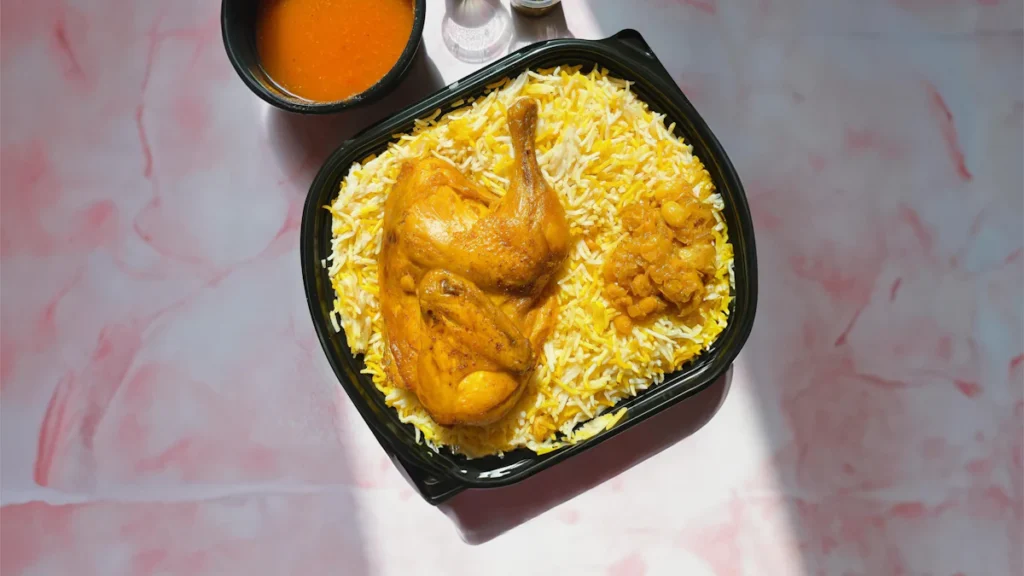
Mandi has spread from Yemen across the Gulf and into India, where cities such as Hyderabad now have entire streets of mandi restaurants. If you have seen it on a menu in Goa and wondered what is mandi and how it differs from biryani, the short version is this: it is a dish of long-grain rice and very tender meat, cooked so that the meat’s juices and fat drip down into the rice. It is gently spiced, smoky and built for sharing.
Quick answer: Mandi is a Yemeni dish of meat (usually lamb, goat or chicken) and basmati rice. The meat is boiled with whole spices, then suspended above the rice in a sealed pit or tandoor-style oven so its juices drip into the rice as both cook slowly. It is seasoned with a spice mix such as hawaij, served on a large communal platter and eaten with a tangy tomato-chilli sauce and salad.
Where mandi comes from
Mandi is strongly associated with Yemen and is often linked in particular with the Hadhramaut region in the south of the country, whose people migrated widely across the Arabian Peninsula, East Africa and South Asia. The dish travelled with them. Today it is eaten throughout Saudi Arabia, Oman, the UAE and the wider Gulf, and in India it has a firm foothold in Hyderabad, where the Barkas neighbourhood has a large community of Hadhrami descent, as well as in Kerala and coastal Karnataka.
The name is often said to come from the Arabic nada, meaning dew, a reference to the moist, dewy texture of the meat. Treat that as a popular explanation rather than settled fact.
How mandi is cooked
The traditional pit
In its classic form, mandi is cooked in a deep clay-lined pit or underground oven. Wood is burned inside until it becomes glowing charcoal. The meat, already boiled with whole spices, is hung or placed on a rack above a pot of rice that is cooking in the spiced stock. The pit is then sealed so the heat and smoke are trapped. As the hours pass, fat and juices from the meat drip into the rice below, and the whole thing picks up a light smokiness.
The modern restaurant method
Many restaurants use a tandoor, a large sealed drum oven or a combination of pressure cooking and finishing in an oven. Some add a “smoking” step by placing a piece of hot charcoal in a small bowl of oil inside the closed pot. The goal is the same: very soft meat, fragrant rice and a hint of smoke.
The spices
Mandi is not fiery. The flavour comes from whole spices such as cardamom, cloves, black pepper, cinnamon, bay leaf and dried lime, plus a spice mix such as hawaij (which typically includes cumin, black pepper, turmeric and cardamom). Saffron, fried onions, raisins and toasted nuts often go on top.
Mandi vs biryani vs kabsa
| Mandi | Biryani | Kabsa | |
|---|---|---|---|
| Origin | Yemen | South Asia | Saudi Arabia and the Gulf |
| Cooking | Meat cooked above the rice, dripping into it, often smoked | Rice and marinated meat layered and cooked together (dum) | Meat and rice cooked together in a tomato-based stock |
| Heat | Mild, aromatic | Can be very spicy | Mild to medium |
| Colour | Pale rice with saffron streaks | Mixed, often coloured | Orange-red |
Mutton or chicken mandi?
Mutton (or lamb) mandi is the classic celebration version. The long cooking time suits it: bone-in shoulder or leg becomes soft enough to pull apart with your fingers, and the fat gives the rice its richness. Chicken mandi is quicker, lighter and usually cheaper, and it is popular as an everyday order. If you only try mandi once, mutton gives you the more traditional experience.
How to eat mandi
- Share it. Mandi arrives on a large platter meant for the table. In many mandi restaurants people sit around one plate.
- Use your right hand if you are eating traditionally, pressing rice and meat together into a small ball.
- Add the sauce. Mandi is served with a sharp tomato and chilli sauce (called zahawig in Yemen and dakkous in Saudi Arabia) to spoon over the rice.
- Balance it with salad. A fresh chopped salad and sometimes yoghurt cut through the richness.
Mutton Mandi on the Dubki menu
Dubki lists Mutton Mandi as a main course at ₹795, which makes it, jointly with the seafood paella, the highest-priced dish on the menu. The menu card does not describe the cooking method or the sides served with it, so we cannot tell you whether it is smoked or served with a tomato sauce; if those details matter, call +91 86238 88190 before you go. Adding the 10% service charge and around 5% GST, it comes to roughly ₹920 on the bill (an estimate).
Since mandi is a sharing dish by nature, it works well as the centrepiece for two or three people with a couple of starters. Our full guide to Dubki’s Mutton Mandi covers what to order with it, and the cost for two page shows how a mandi-led meal adds up.
FAQs
Is mandi spicy?
No, mandi is mild and aromatic. Heat comes from the side sauce, which you add to taste.
Is mandi the same as biryani?
No. In biryani the meat and rice cook together in layers; in mandi the meat cooks above the rice and drips into it.
How many people does one mandi serve?
It depends on the restaurant. Portions vary widely, so ask when ordering.
Is mandi halal?
It is traditionally made with halal meat, but restaurants differ. Ask the venue directly if this matters to you.
For more slow-cooked and grilled mutton, see our guide to mutton dishes, or browse the Dubki non-veg menu.
Pingback: Dubki Mutton Mandi: Price, Pairings and What to Expect - Dubki Menu